



With Funding for Lending (FLS) figures showing that net lending to businesses and households is still being squeezed, data has revealed that three high street groups contracted net lending by a combined £4.9 billion in 2013 Q1.
The Bank of England data published yesterday depicted net lending in the first quarter of the year at minus £0.3 billion. It is the second consecutive quarter in which the net lending figures have decreased.
Differentiating the differences in net lending volumes across participants in the scheme, 27 out of 40 participating groups increased their lending in 2013 Q1, lending a net £5.1 billion to the UK real economy.
However, 13 groups that contracted their net lending did so by a combined £5.4 billion (Chart 1).
Chart 1: Net lending by FLS participants

(a) Net flows of sterling lending to UK households and private non-financial corporations. Non-seasonally adjusted.
(b) The sum of net lending by those participants with positive net lending during the quarter.
(c) The sum of net lending by those participants with negative net lending during the quarter.
Of that contraction, £4.9 billion was accounted for by three large groups, equalling 91 per cent of the total contraction.
The detailed figures showed taxpayer-backed Royal Bank of Scotland, Lloyds Banking Group, and Santander largely responsible for the shrinking lending picture (Chart 2). RBS and Lloyds in particular are battling to reduce the bloated commercial property lending portfolios built up before the financial crisis.
In part, that reflects a desire by several major UK lenders to reduce the scale of their so-called ‘non-core’ loan portfolios following the financial crisis, or a need to comply with State Aid conditions. But the rate of that contraction slowed in 2013 Q1.
Chart 2: Lloyds, RBS, Santander FLS usage and lending data
|
FLS Group |
Certified lending to UK households and PNFCs (£m) |
Aggregate outstanding FLS drawings as at 31/03/13 (£m) |
||
|
Base stock of loans as at 30/06/12 |
Q1 2013 net lending flow |
Cumulative net lending since 30/06/12 |
||
|
TOTAL (40 participants) |
1,364,448 |
-300 |
-1,790 |
16,453 |
|
Lloyds Banking Group |
443,255 |
-983 |
-6,619 |
3,000 |
|
RBS Group |
214,793 |
-1,620 |
-3,978 |
750 |
|
Santander |
189,339 |
-2,296 |
-8,603 |
1,000 |
According to the figures, what is most surprising is the constant negative net flow of these three high street institutions. Since the scheme was unveiled at the end of June 2012, net lending by these three participating banks has also fallen by £19.2 billion.
The 40 groups participating in the scheme cover over 80 per cent of the stock of lending to the real economy.
Nationwide Building Society led lending in the first quarter, with £1.2 billion of positive net flows. Barclays Plc made £1.1 billion of loans. Co-Operative Bank Plc’s lending fell £12 million.
All the challenger banks were on the up; Aldermore Bank’s net lending of £230 million to the UK economy was in the top six of all the lenders in the entire scheme. Metro Bank lent £78 million, and Shawbrook Bank lent £119 million.
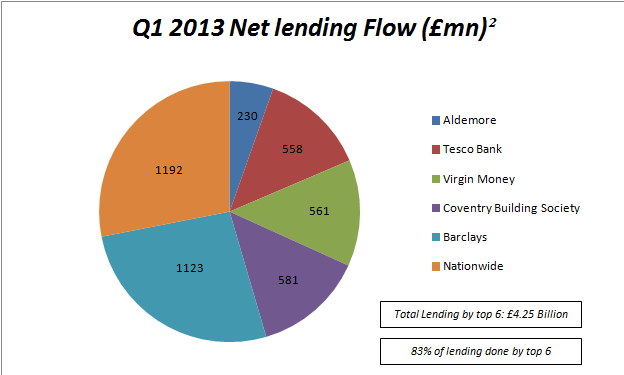
The FLS aims to encourage more lending to the UK economy than would have been the case in the absence of the Scheme. It creates incentives for banks and building societies to boost their lending by reducing their funding costs, which allows them to reduce the price of new loans and therefore increase net lending.
The Bank and HM Treasury announced an extension to the FLS on 24 April 2013, with three main objectives: to give banks and building societies confidence that funding for lending to the UK real economy will be available on reasonable terms until January 2015; to increase the incentive for banks to lend to SMEs both this year and next; and to include lending involving certain non-bank providers of credit, which play an important role in providing finance to the real economy. The extension has been positively received, with many banks and building societies intending to participate in the extension.
“The picture of flat lending growth overall is broadly as expected at this stage reflecting reductions in some legacy portfolios being roughly offset in aggregate by expanding new lending,” BOE Markets Director Paul Fisher said.
He added: “The plans of the FLS participants suggest that net lending volumes will pick up gradually through the remainder of 2013.”
Since the scheme was unveiled last summer, net lending by participating banks has fallen by £1.8 billion.

Leave a comment